Proprietary Blend Explained: Reading the Lungora 575 mg Line
Quick answer
A proprietary blend lists one total weight and the ingredient names from most to least, with no amount for each. FDA rules allow it. On Lungora, magnesium shows 80 mg because it has a Daily Value; the other five share a 575 mg blend that also holds the magnesium glycinate. The blend total is smaller than one 600 mg alpha lipoic acid study dose.
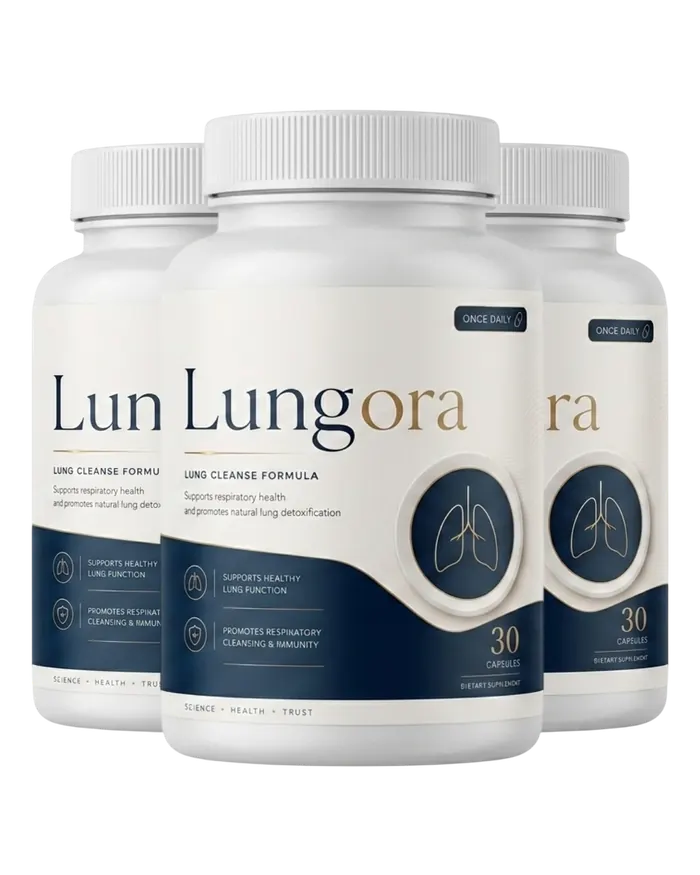
Turn a Lungora bottle around and one line does most of the talking: Proprietary Blend, 575 mg. Under it sit six ingredient names and no other numbers. This guide explains what that line means in US labeling law, what it lets you work out, and what it keeps out of view.
What does proprietary blend mean on a supplement label?
It is a group of ingredients listed under one total weight instead of one weight each. The federal rule for supplement labels lets a maker print the blend under the name Proprietary Blend, or something like it, give the combined weight, and list the ingredients in descending order of predominance by weight (21 CFR 101.36, Nutrition labeling of dietary supplements (eCFR)).
The FDA labeling guide says the same in plainer terms. The total weight goes on the blend’s line, the ingredients go underneath from most to least, and only ingredients with a Daily Value must be listed on their own with an amount (FDA, Dietary Supplement Labeling Guide, Ch. IV).
So a blend is legal, but it is not a dose list. A 2023 review in The Journal of Nutrition says the label cannot tell you how much of any single ingredient a person takes (J Nutr, Perspectives on proprietary blends).
Curious about Lungora? The 6-bottle order gives the lowest price per bottle.
6 bottles at $49 each, $294 total. 60 days to request your money back · Ships free on 3 or 6 · Paid via BuyGoods.
What does the Lungora label actually show about its blend?
One amount for one ingredient, one total for the rest. Tap a number on the flat label to read its note; the list under the picture repeats every note.
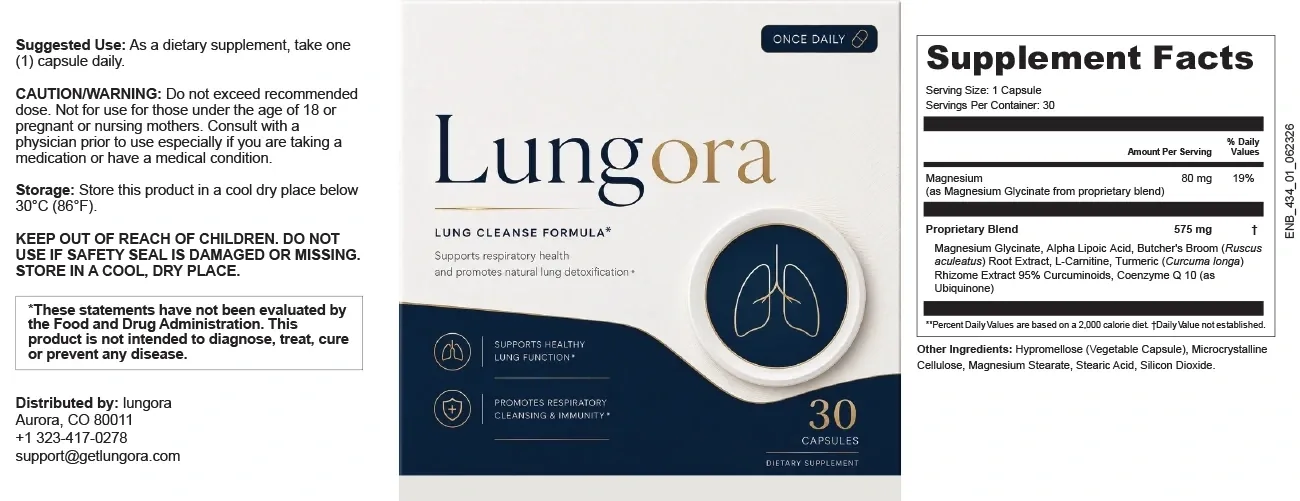
- Serving size. 1 capsule, 30 servings per container. Every amount below is for a single capsule.
- Magnesium, 80 mg, 19% DV. The only ingredient with its own amount, because magnesium has a Daily Value. The label says it comes from the blend.
- Proprietary Blend, 575 mg. The combined weight of everything in the blend, magnesium glycinate included.
- The six names. Magnesium glycinate, alpha lipoic acid, butcher’s broom root extract, L-carnitine, turmeric extract 95% curcuminoids, coenzyme Q10. No amounts.
- Dagger footnote. Daily Value not established for the blend, so no percentage is shown.
- Other ingredients. Hypromellose capsule, microcrystalline cellulose, magnesium stearate, stearic acid, silicon dioxide. These are not part of the 575 mg.
- Front claim. LUNG CLEANSE FORMULA with an asterisk that points to the FDA disclaimer box.
Our word-for-word copy of the panel is on the Lungora Supplement Facts page.
What do FDA rules require a blend to show, and what can stay hidden?
They require the name, the total and the order, but not each ingredient’s weight. The right column shows how the Lungora label handles each line.
| Label item | Required? | On the Lungora label |
|---|---|---|
| A blend name | Yes, Proprietary Blend or a similar name | Proprietary Blend |
| Total weight of the blend | Yes | 575 mg |
| Ingredients in order, heaviest first | Yes | Six names, starting with magnesium glycinate |
| Amount of a nutrient with a Daily Value | Yes, listed on its own line | Magnesium 80 mg, 19% DV |
| Weight of each other ingredient | No | Not published |
| Strength of each extract | No | Only turmeric gives one: 95% curcuminoids |
Sources: (21 CFR 101.36, Nutrition labeling of dietary supplements (eCFR)) (FDA, Dietary Supplement Labeling Guide, Ch. IV). Because the list must run from most to least, magnesium glycinate is meant to be the largest part of the blend and coenzyme Q10 the smallest. The rule gives you the order, never the gaps between.
How much of each ingredient is in the Lungora 575 mg blend?
Nobody outside the company can say, because the amounts are not published. A few comparisons are still safe because they need only the blend total. Bars without a fill mean the amount is hidden.
Label: 80 mg. Studied: 420 mg Daily Value; 350 mg a day upper limit from supplements. (NIH ODS, Magnesium (health professional)) (NIH ODS, Magnesium (consumer))
Label: hidden in the 575 mg blend. Studied: 600 mg a day in most oral trials. (Linus Pauling Institute, Lipoic Acid) (LiverTox, Alpha Lipoic Acid)
Label: hidden in the 575 mg blend. Studied: 500 to 2,000 mg a day usual supplement range. (Linus Pauling Institute, L-Carnitine) (NIH ODS, Carnitine (health professional))
Label: hidden in the 575 mg blend. Studied: 30 to 100 mg a day typical; 100 to 300 mg in trials. (Linus Pauling Institute, Coenzyme Q10) (NCCIH, Coenzyme Q10)
Label: hidden in the 575 mg blend. Studied: EMA: 150 to 200 mg extract per dose, for heavy legs. (EMA/HMPC, EU herbal monograph on Ruscus aculeatus root (Rev. 1))
Label: hidden in the 575 mg blend. Studied: about 80 mg to 4 g curcumin a day in trials. (Linus Pauling Institute, Curcumin) (NCCIH, Turmeric: Usefulness and Safety)
Three comparisons the label does allow
- The whole 575 mg blend weighs less than the single 600 mg oral dose of alpha lipoic acid used in trials (Linus Pauling Institute, Lipoic Acid). Alpha lipoic acid is only one of six names in it.
- It also weighs less than the 750 mg a day of L-carnitine used in one osteoarthritis trial (NIH ODS, Carnitine (health professional)).
- Usual L-carnitine doses run 0.5 to 2 g a day (Linus Pauling Institute, L-Carnitine). Even 500 mg in this blend would leave under 75 mg for the other five ingredients together.
Past that, any per-ingredient number is a guess, and we do not print guesses. The L-carnitine page and the alpha lipoic acid page go deeper on the study doses.
Why is the 80 mg of magnesium not added to the 575 mg blend?
Because it is already inside it. The label lists magnesium as coming from the proprietary blend, so the 80 mg is part of the 575 mg, not on top of it.
Also, 80 mg is the magnesium itself. The magnesium glycinate that carries it weighs more, and none of our sources gives the exact share, so we do not work out how much of the blend it fills.
For context, 80 mg is 19% of the 420 mg Daily Value and well under the 350 mg a day upper limit for magnesium from supplements (NIH ODS, Magnesium (health professional)). Our magnesium glycinate page covers the rest.
Why are proprietary blends criticized?
Because a buyer, a doctor or a researcher cannot check the dose. The Journal of Nutrition review notes that researchers who want the amounts must test products in a lab or ask the makers, and makers are not obliged to answer (J Nutr, Perspectives on proprietary blends).
That matters for evidence. FTC guidance tells advertisers to ask how the dose and formulation of their product compare with what was studied, since a mismatch can make a study irrelevant (FTC, Health Products Compliance Guidance). With a blend, nobody outside the company can run that check. Here is how Lungora does on basic facts.
8 of 12 key facts are published
- Product name and formPublished
- Capsules per bottlePublished
- Daily servingPublished
- Ingredient namesPublished
- Supplement Facts panelPublished
- Magnesium amountPublished
- Amount of each blend ingredientNot published
- Prices and packsPublished
- Guarantee lengthPublished
- Manufacturer namedNot published
- Third-party lab reportNot published
- Study of this productNot published
What should you ask a seller about a proprietary blend?
Ask for numbers in writing, and judge the answer by how specific it is. These questions work for any blend.
- How many milligrams of each blend ingredient are in one serving?
- Which extract is used, and what is it standardized to? (Only the turmeric line gives a figure here.)
- Who manufactures the product? The label names only a distributor in Aurora, Colorado.
- Is there a certificate of analysis for my lot from an outside lab, and can I see it?
- Which study, at which dose, supports the claim on the front of the bottle?
For Lungora, the order desk is at +1 (323) 417-0278 and [email protected]. A vague reply is an answer too.
Questions about proprietary blends
Is a proprietary blend a secret recipe?
Partly. The label must give the total weight and the order of ingredients by weight, but it can keep each amount private.
Why are proprietary blends bad?
They are not unsafe by definition, but they hide each dose. That makes it impossible to compare the product with the doses used in studies.
How much alpha lipoic acid is in Lungora?
Not published. The whole 575 mg blend is smaller than the single 600 mg oral dose used in alpha lipoic acid trials.
Should I add 80 mg and 575 mg to get the capsule total?
No. The label says the magnesium comes from the blend, so the 80 mg is already inside the 575 mg total.
What does the dagger next to 575 mg mean?
Daily Value not established. There is no official daily target for the blend, so no percentage can be shown.
Will a seller tell me the exact blend amounts?
You can ask, but makers do not have to answer. If the amounts are not given in writing, treat them as unknown.
Page check
Written by
Reads every line of the bottle label and checks each health statement against NIH, CDC, FDA and American Lung Association pages.
- Label check date: October 13, 2026
- Built from the printed bottle label, the brand order and policy pages, and the health sources cited in the text
- See something wrong? Tell us at [email protected], and read how this site checks claims