CoQ10 in Lungora: An Antioxidant With No Lung Research
Quick answer
Lungora lists coenzyme Q10 as ubiquinone, one of six ingredients sharing a 575 mg blend with no single amounts. Typical supplements hold 30 to 100 mg, under 5% of a dose is absorbed, and trials show no benefit for statin muscle pain. No source covers the lungs. It can change how warfarin works and may slow clearance of theophylline, a lung medicine.
Does CoQ10 help the lungs or breathing?
Not according to anything we found. The Linus Pauling Institute, NCCIH and Memorial Sloan Kettering pages on CoQ10 contain no lung or COPD research at all.
The Lungora sales page files CoQ10 next to turmeric as an antioxidant for "everyday oxidative stress". That is a general claim, and NCCIH's review of antioxidant supplements found they did not prevent cancer or heart disease (NCCIH, Antioxidant Supplements: What You Need To Know).
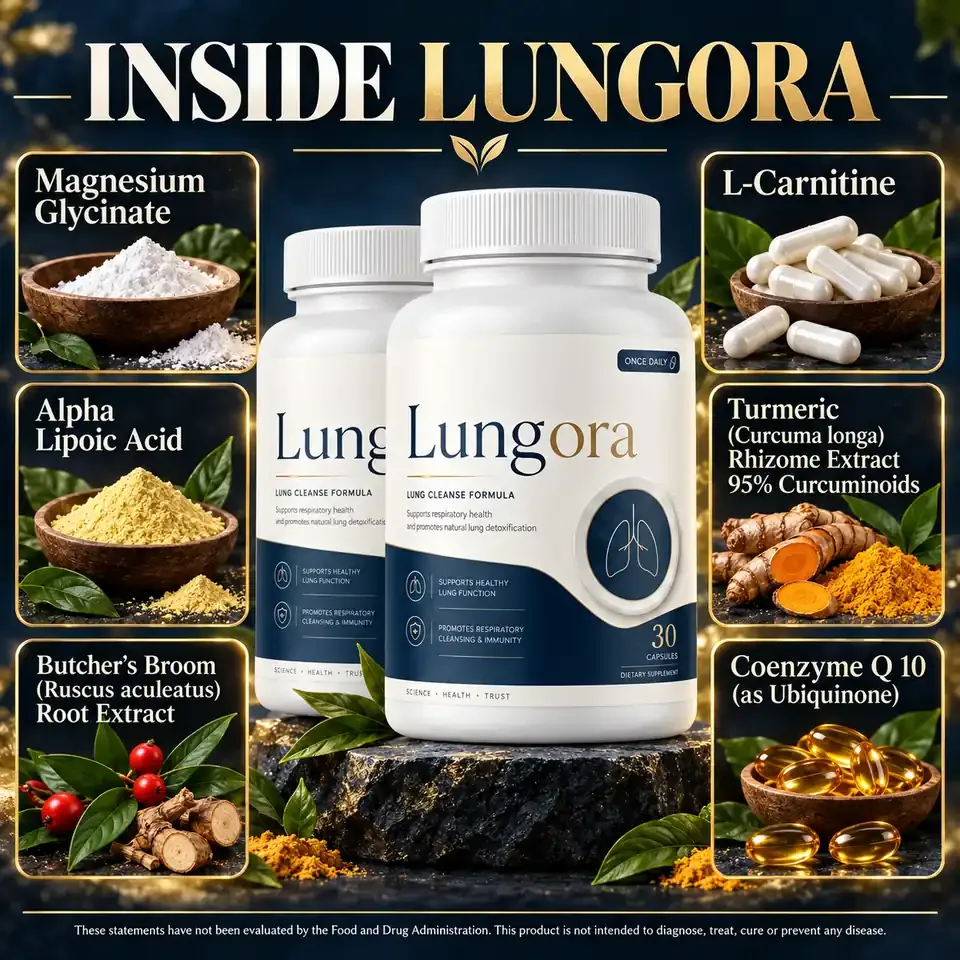
- The CoQ10 tile. Drawn as amber softgels. Lungora itself is a vegetable capsule (hypromellose), so the picture is decoration.
- The bottle front. Lung cleanse wording on the label, while the sales page calls CoQ10 an antioxidant.
- Its antioxidant partner. Turmeric extract shares the antioxidant slot on the sales page.
- The small print. A line saying the FDA never reviewed these claims and that no disease is meant to be treated.
How much CoQ10 do supplements and trials use?
Most supplements hold 30 to 100 mg a day, and heart failure trials went up to 300 mg. Those numbers are the yardstick, but the Lungora label gives no CoQ10 figure to hold against them.
| Setting | Daily dose | What happened |
|---|---|---|
| Typical supplement | 30 to 100 mg | The common range on shelves |
| Heart failure, 14 trials | 30 to 300 mg | Lower death rate in 7 studies and better exercise capacity |
| Statin muscle pain | 100 to 400 mg for 1 to 3 months | No reduction in muscle pain |
| CoQ10 deficiency treatment | 1,200 to 3,000 mg | Far above any typical supplement |
| Stomach upset threshold | 200 mg or more | Where upset mostly appears |
| Lungora capsule | Not published | One unknown share of 575 mg |
Unlike L-carnitine, a typical CoQ10 amount could fit inside the blend. Whether it does is something only the maker knows. The full label is explained on our supplement facts page.
Curious about Lungora? The 6-bottle order gives the lowest price per bottle.
6 bottles at $49 each, $294 total. 60 days to request your money back · Ships free on 3 or 6 · Paid via BuyGoods.
Is CoQ10 absorbed from a capsule?
Only a little. The Linus Pauling Institute estimates that under 5% of a swallowed dose reaches the bloodstream, and says CoQ10 is best absorbed with fat in a meal.
The Lungora directions say only "take one (1) capsule daily", with no word about food. The label names the ubiquinone form, but the sources we read treat CoQ10 as one compound and do not rank forms, so we make no claim either way.
What did CoQ10 studies find for the heart and muscles?
A mixed picture with more misses than hits. The strongest signal is in heart failure, and even there the sources do not agree.
Heart failure
A 14-trial meta-analysis found lower death rates and better exercise capacity. NCCIH still calls the heart failure evidence inconclusive (NCCIH, Coenzyme Q10).
Coronary heart disease
Memorial Sloan Kettering says a systematic review did not support routine use, despite some positive studies (Memorial Sloan Kettering, Coenzyme Q10 (About Herbs)).
Statin pain, blood pressure, Parkinson's
No muscle pain relief, probably no meaningful blood pressure effect, and no benefit in a major NIH Parkinson's study or in Huntington's trials.
None of these studies involved breathing, and none tested CoQ10 inside a mixed capsule like this one.
Can you take CoQ10 with warfarin?
Only with the clinician who manages your warfarin in the loop. The sources disagree on which way CoQ10 pushes, so the honest summary is that it can change how warfarin works and blood tests are needed.
The Linus Pauling Institute says CoQ10 may weaken warfarin. Memorial Sloan Kettering says it may raise bleeding risk with blood thinners and may also work against warfarin. NCCIH simply says the two may interact. Here is a sensible order of steps drawn from those pages.
- Before
Ask first
The Linus Pauling Institute says people on warfarin should not start CoQ10 without their provider.
- Weeks 1 to 2
Frequent INR checks
INR, the clotting test, should be checked often, especially in the first two weeks.
- Ongoing
Count every source
Turmeric and L-carnitine in Lungora carry bleeding cautions of their own.
- Surgery
Tell the team
NCCIH advises telling providers about supplements well before an operation.
Turmeric's bleeding note is on the turmeric page, and L-carnitine's on the L-carnitine page.
CoQ10 with theophylline, cancer treatment and breastfeeding
Theophylline is the caution most specific to a lung audience. Memorial Sloan Kettering says CoQ10 may slow how fast the body clears this asthma and COPD medicine, with risks of "persistent vomiting, cardiac arrhythmia, and intractable seizures".
Chemotherapy and radiation
Antioxidants may reduce the effect of some cancer treatments. A 2019 observational study described by NCCIH linked antioxidant supplements, CoQ10 among them, taken during chemotherapy with more breast cancer recurrence and death. Memorial Sloan Kettering asks anyone having chemotherapy or radiation to talk to their doctor first.
Breastfeeding and everyday side effects
The Linus Pauling Institute advises avoiding CoQ10 while breastfeeding, as no reliable data exist, and the Lungora label rules out nursing, pregnancy and under 18. Reported side effects are mild: trouble sleeping, nausea, diarrhea, loss of appetite and stomach upset. The full list for the capsule is on the side effects page.
Is the CoQ10 in Lungora worth it?
Not as a lung ingredient. It has a real heart failure literature, but no lung research, an unknown amount here, and a medicine interaction that matters to people on theophylline.
To see it beside the other five, open the Lungora ingredients overview.
CoQ10 questions from readers
Is CoQ10 good for COPD?
None of our CoQ10 sources studies COPD or any lung disease. The one lung link we found runs the other way: Memorial Sloan Kettering warns that CoQ10 could keep theophylline in the body longer, a medicine some people with COPD or asthma take.
Can CoQ10 cause breathing problems?
Breathing trouble is not on the side effect lists we read, which name sleeplessness, nausea, diarrhea, loss of appetite and stomach upset. New or worse breathlessness has other causes and deserves a clinician's look.
How much CoQ10 is in Lungora?
The label does not say. CoQ10 is the last of six ingredients in the 575 mg blend, so its share is unknown, even though a typical 30 to 100 mg amount could fit.
What does "as ubiquinone" mean on the label?
It names the form of coenzyme Q10 the maker used. The NIH, Linus Pauling Institute and Memorial Sloan Kettering pages we read discuss CoQ10 in general and do not compare forms, so we cannot say whether the form changes anything here.
Can you take CoQ10 and blood thinners together?
Only with your prescriber involved. Our sources disagree on whether CoQ10 weakens warfarin or raises bleeding risk, so the safe reading is that it can change how warfarin works and INR checks are needed.
Does CoQ10 lower blood pressure?
Probably not in a way that matters. NCCIH says CoQ10 "probably doesn't have a meaningful effect on blood pressure", so it should not replace a blood pressure medicine.
Should CoQ10 be taken with a meal?
The Linus Pauling Institute says it is best absorbed with fat in a meal. The Lungora label gives no timing, so taking the capsule with a meal that contains some fat is a reasonable habit to discuss with your pharmacist.
Does CoQ10 help muscle pain from statins?
The evidence says no. A meta-analysis of 100 to 400 mg a day, described by the Linus Pauling Institute, found no drop in muscle pain, and NCCIH reaches the same overall view.
Page check
Written by
Reads every line of the bottle label and checks each health statement against NIH, CDC, FDA and American Lung Association pages.
- Label check date: October 13, 2026
- Built from the printed bottle label, the brand order and policy pages, and the health sources cited in the text
- See something wrong? Tell us at [email protected], and read how this site checks claims