Lungora Ingredients: The Six Names and Their Research
Quick answer
Lungora lists six ingredients: magnesium glycinate, alpha lipoic acid, butcher's broom, L-carnitine, turmeric extract and CoQ10.
Only magnesium has its own amount, 80 mg, and all six share a 575 mg blend. Their research covers nerves, leg veins, the heart and joints.
What are the Lungora ingredients? Six names on one small panel
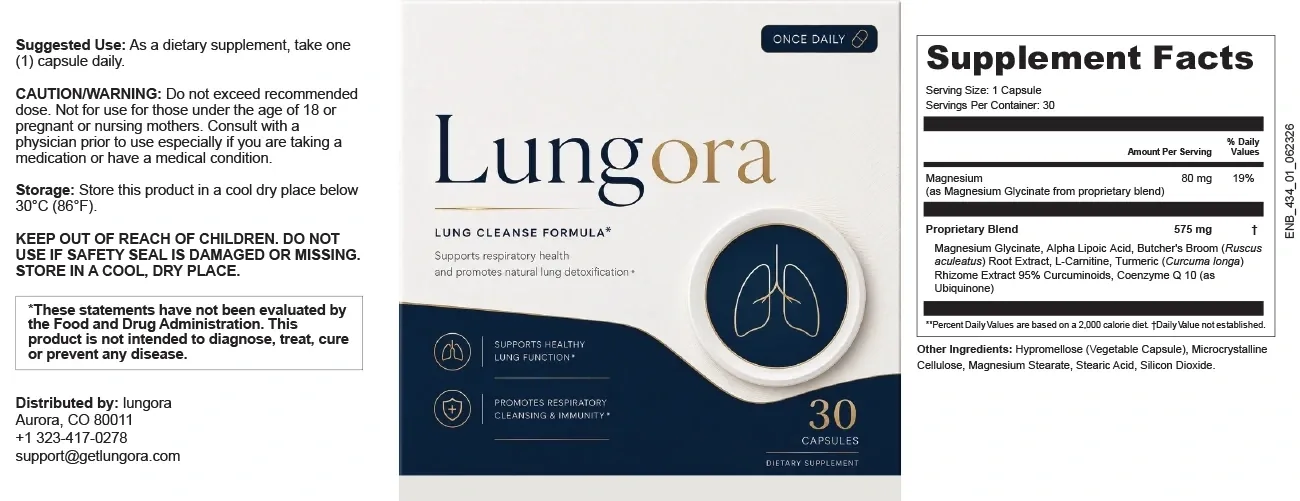
Lungora lists six ingredients per capsule. Only magnesium gets a number, 80 mg; all six share a 575 mg proprietary blend.
| Label name | What it is | Per capsule | Main research use in our sources | Human lung study? |
|---|---|---|---|---|
| Magnesium glycinate | Mineral bound to glycine | 80 mg magnesium (19% DV) | Daily intake and upper limits | None found |
| Alpha lipoic acid | Antioxidant compound | not printed | Diabetic nerve symptoms | None; rat data only |
| Butcher's broom root extract | Root extract, Ruscus aculeatus | not printed | Heavy legs from minor vein problems | None found |
| L-carnitine | Compound the body makes itself | not printed | Heart, blood sugar, exercise (mixed) | None found |
| Turmeric extract, 95% curcuminoids | Concentrated root spice extract | not printed | Knee arthritis (early evidence) | None; animal data only |
| Coenzyme Q10 (ubiquinone) | Vitamin-like compound | not printed | Heart failure, statin muscle pain | None found |
The last column is the point: a bottle labeled "Lung Cleanse Formula" holds six ingredients with no human lung study between them in our sources.
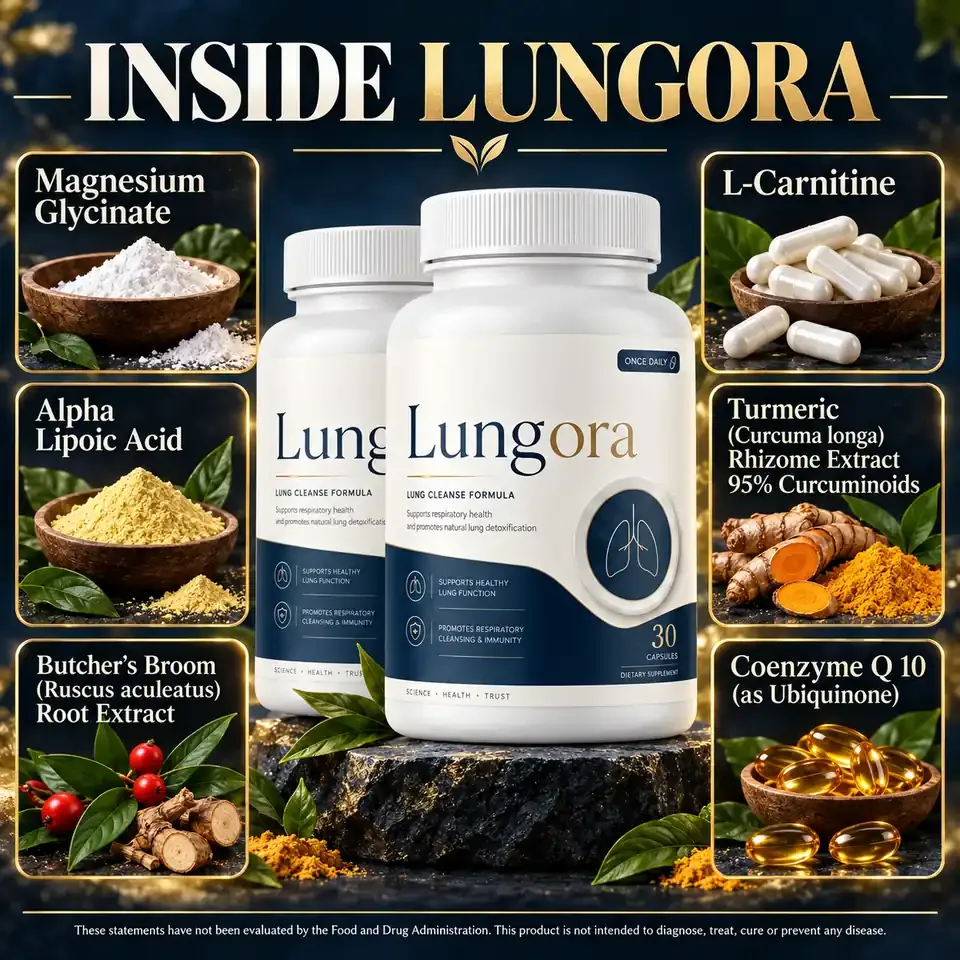
What does the "Inside Lungora" graphic show, and what does it leave out?
All six names with powders, roots and pills, but no amounts and no lung research. Tap a number for the details.
- Magnesium glycinate. No amount shown; the label's 80 mg counts the magnesium, not the whole compound.
- Butcher's broom. Berries and leaves are styling. The capsule holds a root extract only.
- L-carnitine. Drawn as white capsules, which says nothing about how much each capsule holds.
- Coenzyme Q10. Gold softgels are a prop. Lungora uses a hypromellose capsule.
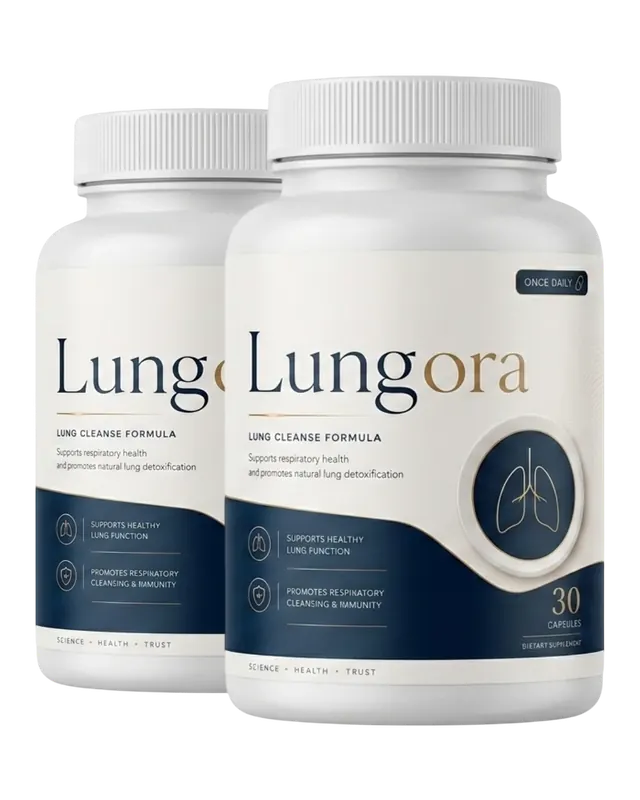
- The bottle front. "Promotes respiratory cleansing & immunity" is label wording, not a finding.
- The small print. The FDA has not evaluated these statements.
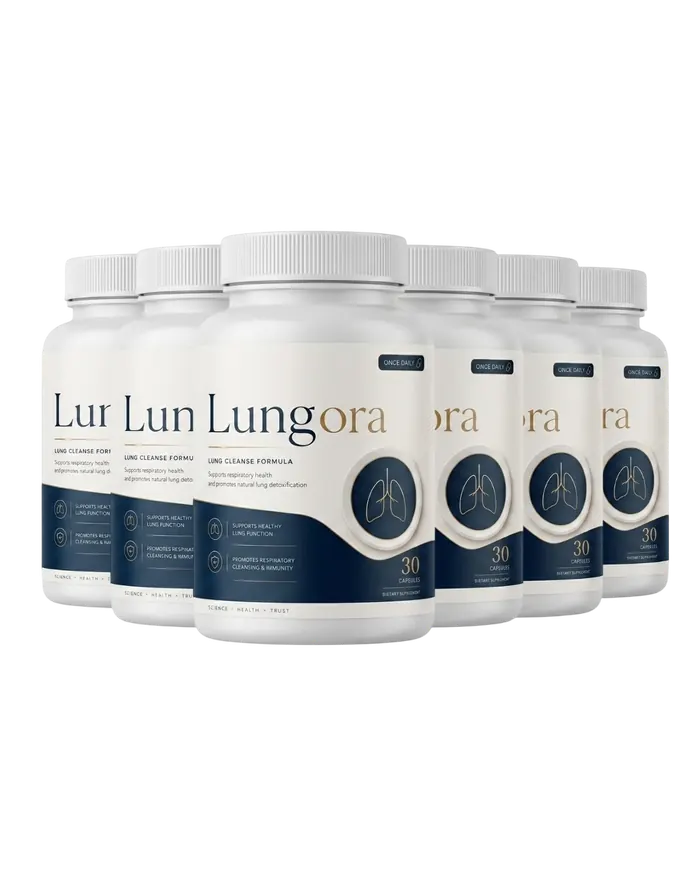
Curious about Lungora? The 6-bottle order gives the lowest price per bottle.
6 bottles at $49 each, $294 total. 60 days to request your money back · Ships free on 3 or 6 · Paid via BuyGoods.
Are the Lungora ingredients for lungs? What each one was studied for
Not on the evidence we found. Their research records point to nerves, legs, the heart and joints. Select a name.
Mineral
Magnesium glycinate
Supplies the one stated amount, 80 mg. NIH sets a 350 mg daily cap on supplement magnesium and says nothing about lungs or this form (NIH ODS, Magnesium (consumer)).
Studied at: 420 mg Daily Value; 350 mg upper limit from supplements
Antioxidant compound
Alpha lipoic acid
Tested mostly in people with diabetic nerve symptoms. A four-year oral trial found no difference from placebo on its main goal (Linus Pauling Institute, Lipoic Acid).
Studied at: 600 mg daily, swallowed
Root extract
Butcher's broom
A European traditional herbal medicine for heavy, uncomfortable legs and haemorrhoid itching, based on long use rather than trials (EMA/HMPC, EU herbal monograph on Ruscus aculeatus root (Rev. 1)).
Studied at: 150 to 200 mg of dry extract per dose, for legs
Amino acid derivative
L-carnitine
Healthy adults make enough, and little of a supplement is absorbed. Results are mixed for every use NIH reviewed (NIH ODS, Carnitine (health professional)).
Studied at: 500 to 2,000 mg a day
Root spice extract
Turmeric extract
Too little evidence that it helps any health purpose; lung findings are animal or early cancer work (Linus Pauling Institute, Curcumin).
Studied at: about 80 mg to 4 g of curcumin a day
Vitamin-like compound
Coenzyme Q10
Heart failure evidence is inconclusive; a major NIH study found no Parkinson's benefit (NCCIH, Coenzyme Q10).
Studied at: 30 to 100 mg a day in typical products
Meanwhile, the American Lung Association calls the lungs self-cleaning (American Lung Association, Can You Detox Your Lungs?).
Why does the Lungora sales page call these nerve, circulation and antioxidant ingredients?
Because the brand's sales page sorts them into those three pairs. Only the bottle talks about cleansing lungs; the page never says detox, cleanse or immunity.
- Marketing only
Nerve Health Support
Sales page: magnesium glycinate and alpha lipoic acidTied to "healthy nerve signaling", not breathing.
- Marketing only
Circulation & Cellular Support
Sales page: butcher's broom and L-carnitineFits butcher's broom's leg-vein history. Not a lung claim.
- Marketing only
Antioxidant & Healthy Aging Support
Sales page: turmeric extract and CoQ10NCCIH says antioxidant pills have not been shown to prevent cancer or heart disease (NCCIH, Antioxidant Supplements: What You Need To Know).
- On the label
Lung cleanse formula
Bottle frontCarries the FDA asterisk. No source we opened supports any pill that cleanses the lungs.
- On the label
Promotes respiratory cleansing & immunity
Bottle frontThe NIH fact sheet on supplements for immune function covers none of the five blend extras and mentions magnesium only in passing (NIH ODS, Dietary Supplements for Immune Function and Infectious Diseases).
How much of each ingredient is in the 575 mg proprietary blend?
Nobody outside the company can say. The label prints one total, 575 mg, for six ingredients, and federal rules allow that: only nutrients with a Daily Value, like magnesium, need their own amount (21 CFR 101.36, Nutrition labeling of dietary supplements (eCFR)).
Arithmetic that holds without guessing
- The 80 mg of magnesium sits inside the 575 mg; never add the two.
- Magnesium glycinate weighs more than its 80 mg of magnesium, so the other five share less than 495 mg.
- The whole blend is lighter than the 600 mg oral alpha lipoic acid trial dose, and than one 750 mg L-carnitine trial dose.
- L-carnitine at 500 mg, the low end of usual doses, would leave under 75 mg for everything else.
FDA guidance orders blend names by weight, largest first (FDA, Dietary Supplement Labeling Guide, Ch. IV). If this label follows that rule, magnesium glycinate is the largest share and coenzyme Q10 the smallest. Researchers note that blend labels leave the dose of each single ingredient unknowable (J Nutr, Perspectives on proprietary blends).
Each label amount against studied doses
Label: 80 mg. Studied: 420 mg Daily Value; 350 mg a day upper limit from supplements. (NIH ODS, Magnesium (health professional)) (NIH ODS, Magnesium (consumer))
Label: hidden in the 575 mg blend. Studied: 600 mg a day in most oral trials. (Linus Pauling Institute, Lipoic Acid) (LiverTox, Alpha Lipoic Acid)
Label: hidden in the 575 mg blend. Studied: 500 to 2,000 mg a day usual supplement range. (Linus Pauling Institute, L-Carnitine) (NIH ODS, Carnitine (health professional))
Label: hidden in the 575 mg blend. Studied: 30 to 100 mg a day typical; 100 to 300 mg in trials. (Linus Pauling Institute, Coenzyme Q10) (NCCIH, Coenzyme Q10)
Label: hidden in the 575 mg blend. Studied: EMA: 150 to 200 mg extract per dose, for heavy legs. (EMA/HMPC, EU herbal monograph on Ruscus aculeatus root (Rev. 1))
Label: hidden in the 575 mg blend. Studied: about 80 mg to 4 g curcumin a day in trials. (Linus Pauling Institute, Curcumin) (NCCIH, Turmeric: Usefulness and Safety)
What are the other ingredients in Lungora capsules?
Five helpers: a shell, a filler, two slip agents and a flow aid. They sit outside the 575 mg blend, unweighed.
- Hypromellose
- The capsule shell, made from plant cellulose. This is what "vegetable capsule" on the label means.
- Microcrystalline cellulose
- Purified plant fiber used as a filler, so every capsule reaches the same fill weight.
- Magnesium stearate
- A slip agent that stops powder sticking to machines. Not the source of the 80 mg.
- Stearic acid
- A fatty acid that does the same lubricating job.
- Silicon dioxide
- A flow aid that keeps fine powder from clumping.
A brand seal calls the formula natural. These processed helpers are normal in capsules; the seal names no certifier.
Which Lungora ingredients need a word with your doctor first?
Four groups should ask before the first capsule. The label also says to consult a physician if you take medicine.
- Blood thinners. Turmeric, CoQ10 and L-carnitine each carry a warfarin or bleeding caution (Memorial Sloan Kettering, Turmeric (About Herbs)) (Linus Pauling Institute, Coenzyme Q10) (Memorial Sloan Kettering, Carnitine (About Herbs)). CoQ10 can change how warfarin works, so INR checks matter.
- Diabetes medicine. Alpha lipoic acid in large amounts can push glucose down and stack with diabetes drugs (Memorial Sloan Kettering, Alpha-Lipoic Acid (About Herbs)).
- Liver warning signs. On any curcumin product, tiredness, nausea, lost appetite, dark urine or yellowing skin mean stopping and phoning a provider (NCCIH, Turmeric: Usefulness and Safety).
- Under 18, pregnant or nursing. The label says not to use it.
Lungora ingredients: common questions
What are the Lungora ingredients?
Magnesium glycinate (80 mg of magnesium), alpha lipoic acid, butcher's broom root extract, L-carnitine, turmeric extract with 95% curcuminoids and coenzyme Q10, together in a 575 mg blend, plus five capsule helpers.
Does any Lungora ingredient have a human lung study?
Not in the sources we opened. Alpha lipoic acid and curcumin have animal lung findings only, and the other four have none.
Is the 80 mg of magnesium extra to the 575 mg blend?
No. The magnesium comes from the magnesium glycinate inside the blend, so the label's two numbers overlap.
Why doesn't the Lungora label give each blend amount?
US rules let a proprietary blend show one total. Only nutrients with a Daily Value, here magnesium, need their own amount.
Does Lungora contain mullein or NAC?
No. Neither mullein nor N-acetylcysteine is on the label, which lists six ingredients and five capsule helpers.
Why does the Lungora sales page talk about nerves instead of lungs?
It sorts them into nerve, circulation and antioxidant pairs. Lung cleanse and immunity wording appears only on the bottle.
Are Lungora capsules vegetarian?
The shell is hypromellose, a plant-based vegetable capsule. No certifier is named for the brand's vegetarian seal.
Page check
Written by
Reads every line of the bottle label and checks each health statement against NIH, CDC, FDA and American Lung Association pages.
- Label check date: October 13, 2026
- Built from the printed bottle label, the brand order and policy pages, and the health sources cited in the text
- See something wrong? Tell us at [email protected], and read how this site checks claims